
Contents
Securing an innovation grant is only part of funding research and development (R&D). Businesses will also need to consider their own contribution, payment timings, eligible costs, and whether other forms of support, such as R&D Tax Relief, may be relevant.
In this guide, we explore seven leading R&D and innovation funding routes, who they’re suited to, and how they can fit into a wider innovation funding and tax strategy.
R&D Grants & Innovation Funding at a Glance
Short on time? Here’s a quick overview of what UK businesses need to know about R&D grants and innovation funding before exploring the guide in more detail.
Key points:
- What are R&D grants? Usually competitive, non-repayable awards that contribute towards the cost of eligible innovation projects, although your business may still need to fund part of the project itself.
- What funding is available? Key options include Innovate UK, Horizon Europe, Knowledge Transfer Partnerships (KTPs), Eurostars, DASA, and regional or sector-specific innovation grants.
- Who can apply? Eligibility varies between programmes and may depend on your business size, location, sector, project stage, and whether you’re applying independently or with partners.
- How much funding could you receive? There’s no standard amount – grant rates typically range from 25% to 70% of eligible project costs, depending on the programme, your business size, and project stage. Some competitions also set their own total funding caps.
- When should you apply? Ideally, start looking for funding before your project begins, as competitions can have specific rules around project start dates and eligible expenditure.
- Can grants work alongside R&D Tax Relief? Potentially. Receiving grant funding doesn’t automatically prevent an R&D Tax Relief claim, and vice versa, although how the two interact will depend on your circumstances and the applicable rules.
Bottom line: There’s no single R&D grant that’s right for every business. Focus on finding funding that genuinely fits your project, then consider how it could work alongside other innovation incentives as your business develops.
What are R&D grants?
R&D grants are usually competitive (meaning they’re awarded through an application process) and are non-repayable awards that fund part of an eligible innovation project.
Depending on the specific scheme, businesses may use this funding to cover costs such as:
- Feasibility studies (e.g. assessing whether a new technical approach is viable)
- Staff wages (e.g. salaries for engineers or researchers working on the project)
- Product development (e.g. designing and building a new software tool or physical product)
- Prototyping (e.g. creating an early working model to test a concept)
- Materials and testing (e.g. lab consumables or components used during trials)
- Subcontractors and specialist expertise (e.g. hiring a specialist consultant or test facility)
- Collaboration with universities, research organisations, or other project partners (e.g. co-developing a solution with a university research team)
The proportion of funding available depends on the specific competition, the size of the business, and the nature of the project. Each competition has its own eligible cost rules, funding limits, and applicant contribution requirements.
Therefore, it’s a good idea for businesses to review the terms of each opportunity carefully before committing time and resources to an application.
Are R&D grants the same as innovation grants?
There’s a significant overlap between the two terms. “R&D grant” usually emphasises research and development activities intended to resolve technical or scientific challenges. This could include feasibility work, prototyping, or testing.
Meanwhile, an “innovation grant” may have a broader scope. As well as R&D, it may support collaboration, demonstration, commercialisation, adoption, or the development of new business models and services.
Funding bodies may use either term depending on the objectives of the programme, so businesses should focus on the competition’s scope and eligibility criteria rather than its title alone.
Comparing R&D and innovation funding routes
There’s no single R&D grant that suits every business. The right funding route depends on factors such as the stage of development your project is at, whether you need to work with other organisations, your industry, and where your business is based.
The table below summarises seven of the UK’s most common innovation funding routes. We’ll explore each in more detail later in this guide.
| Funding route | Best for | Collaboration required? | Typical applicants |
| Innovate UK funding competitions | Businesses developing innovative products, services or processes | Sometimes | UK businesses, from startups and SMEs to larger companies |
| Horizon Europe | Large-scale research and innovation projects with an international focus | Usually | Businesses, universities, research organisations and consortium partners |
| Knowledge Transfer Partnerships (KTPs) | Businesses looking to access academic or specialist expertise | Yes | UK businesses working with a university, college, or research organisation |
| Eurostars | International, commercially focused R&D projects led by innovative SMEs | Yes | R&D-performing SMEs and international project partners |
| DASA innovation funding | Technologies with potential defence or security applications | Sometimes | Businesses, innovators, universities and research organisations |
| Regional innovation grants | Businesses looking for funding linked to their location | Varies | Businesses meeting regional or local eligibility criteria |
| Sector-specific and local innovation grants | Projects aligned with a particular industry, challenge or local priority | Varies | Businesses operating in eligible sectors or locations |
Although these funding routes all support innovation, they differ significantly in their objectives, eligibility criteria, and funding rules.
Some focus on early-stage feasibility studies, while others are designed to accelerate commercialisation, encourage collaboration across businesses, and positively impact regional economic growth.
Before preparing an application, it’s worth considering not only which programme best aligns with your project, but also how grant funding could fit alongside other innovation incentives, such as R&D Tax Relief or Patent Box, as your business grows.
7 well-established R&D and innovation funding options for UK businesses
UK businesses have more innovation funding options available to them than many realise, and the right fit will depend on your project, sector, stage, and whether you’re working independently or with partners.
Below, we’ve highlighted seven well-established funding options worth exploring, with a closer look at Innovate UK and Horizon Europe for businesses pursuing more ambitious R&D programmes. These aren’t the only options available, but they represent some of the most accessible and commonly used across UK businesses.
1. Innovate UK funding competitions
What it is: The UK’s national innovation agency (part of UKRI), running regular open competitions to co-fund businesses developing new or improved products, processes, and services.
Best suited to: Businesses in manufacturing, digital, engineering, construction, agriculture, life sciences, or clean energy that are actively developing something new, rather than just improving existing processes.
What it can fund: Feasibility studies, industrial research, experimental development, and collaborative R&D projects.
Typical funding: Grant rates typically range from 25% to 70% of eligible project costs, depending on company size and project stage.
Key watch-out: Each competition has its own scope and eligibility rules, so it’s a good idea to check the specific competition guidance before committing time to an application.
Innovate UK is the UK’s national innovation agency, and forms part of UK Research and Innovation (UKRI).
Through regular competitions, it supports businesses developing innovative products or services across a range of sectors, including manufacturing, digital technologies, engineering, construction, agriculture, life sciences, and clean energy.
Competitions vary throughout the year, but commonly fund activities such as feasibility studies, industrial research, experimental development, and collaborative R&D.
Since each competition has its own scope, eligibility criteria, and funding rates, it’s a good idea to review the guidance before deciding whether to apply.
2. Horizon Europe
What it is: The European Union’s flagship research and innovation programme. Following the UK’s association with Horizon Europe, eligible UK organisations can now participate alongside partners across Europe.
Best suited to: Businesses tackling large-scale technical challenges or looking to build international research partnerships, often working alongside universities, research organisations, and industry partners.
What it can fund: Ambitious, collaborative R&D projects with commercial and societal impact.
Typical funding: Can vary by project and funding call. Funding rates and grant values differ significantly across Horizon Europe programmes.
Key watch-out: Projects typically require collaboration with partners in other participating countries. The application process is more involved than most UK national competitions.
Horizon Europe is the European Union’s flagship research and innovation programme. Following the UK’s association with Horizon Europe, eligible UK organisations can collaborate with partners across Europe on ambitious research and innovation projects.
The programme is particularly well suited to businesses tackling large-scale technical challenges or looking to build international partnerships. Projects often involve universities, research organisations, and industry partners working together to deliver innovation with commercial and societal impact.
Our guide to Horizon Europe funding explains how the programme works, who can apply, and what to expect from the application process.
3. Knowledge Transfer Partnerships (KTPs)
What it is: A government-backed programme that funds a collaboration between your business and a university, college, or separate research institution, typically through placing a qualified graduate (an “Associate”) in your business to lead a defined innovation project.
Best suited to: Businesses that need specialist technical or research expertise they don’t have access to in-house, especially those looking to develop new products, services, or processes over a 1-3 year period.
What it can fund: The cost of the Associate’s salary, plus academic supervision, travel, and some project materials. The business contributes a proportion of the total cost.
Typical funding: Businesses typically contribute around 33% of total costs (less for smaller businesses), while the remainder is funded by the grant.
Key watch-out: KTPs are a longer-term commitment compared to a typical grant competition. You can explore options and make an application on the Innovate UK KTP page.
Need specialist expertise that your business doesn’t have in-house? A Knowledge Transfer Partnership (KTP) connects your business with a university, college, or research institution, and funds a highly qualified graduate (known as an Associate) to work in your business and lead a defined innovation project.
So you’re not just gaining access to academic expertise; you’re getting a funded member of staff, supervised by a university team, working exclusively on your project for 1-3 years. Grant funding covers the Associate’s salary, the academic team’s time, project materials, and travel. SMEs typically contribute around 33% of total costs, with the remaining 67% grant funded.
KTPs support the development of new products, services, processes, and are particularly well suited to businesses tackling a specific technical challenge they can’t solve alone.
To explore options and find a knowledge base partner, visit the UKRI KTP guidance pages.
4. Eurostars
What it is: An international funding programme supporting innovative SMEs working with partners in other participating countries to develop commercially focused R&D projects.
Best suited to: SMEs looking to access new expertise, enter international markets, or collaborate on ambitious innovation projects with overseas partners.
What it can fund: Collaborative, market-driven R&D projects aimed at bringing new technologies or solutions to market.
Typical funding: Grant rates and values vary by country, but UK participants are funded through Innovate UK as part of the Eurostars programme.
Key watch-out: You must have at least one partner in another Eurostars participating country, and the lead partner must be an SME.
If you’re looking to collaborate internationally, Eurostars could be worth exploring. The programme is specifically designed for innovative SMEs, supporting them to work with partners in other participating countries on commercially focused R&D projects that bring new technologies to market.
It’s particularly well suited for businesses looking to access new expertise, enter international markets, or take on ambitious innovation projects with overseas partners.
UK-based participants can receive a grant of up to 60% of eligible project costs, capped at approximately €360k per UK partner. Funding is administered through Innovate UK as part of the UK’s involvement in the Eurostars programme.
5. DASA innovation funding
What it is: The Defence and Security Accelerator (DASA) funds innovative ideas that address specific challenges across the UK’s defence and security sectors.
Best suited to: Businesses or researchers developing technology with a credible defence or security application, as it’s open to companies of all sizes as well as academics and individuals.
What it can fund: Early-stage innovation through to more developed solutions, depending on the specific competition or open call.
Typical funding: Varies by competition. Individual awards typically range from around £50k to several hundred thousand pounds.
Key watch-out: Most funding is tied to specific challenge competitions. You can browse current opportunities via UK Defence Innovation regularly, as open calls and competitions are updated throughout the year.
Developing technology with potential defence or security applications? The Defence and Security Accelerator (DASA) funds innovative ideas that address challenges across the UK’s defence and security sectors.
Competitions are typically based around specific challenges, although open calls are also available throughout the year. Past funded projects give a sense of the range:
- Crowd monitoring: an AI and LiDAR-based system developed by Createc and trialled at major UK rail stations and airports, later acquired by Network Rail.
- Personnel tracking: Kinsetsu, an SME based in Northern Ireland, developed a personnel-tracking platform that was later contracted by the Royal Navy for use on HMS Queen Elizabeth and HMS Prince of Wales.
- Space technologies: six organisations were funded to develop capabilities including space telescope systems and satellite threat detection.
Individual awards typically range from £50k-£200k, with larger programme competitions offering more.
To find current open calls and challenge competitions, visit the UK Defence Innovation (the organisation DASA became part of in February 2026).
6. Regional innovation grants
What it is: Innovation grants offered through devolved governments, combined authorities, Growth Hubs, and regional organisations that are separate from national programmes like Innovate UK.
Best suited to: Businesses of any size looking for funding aligned to their region’s economic priorities, or those that may not meet the criteria for national competitions.
What it can fund: Varies by region and programme. Can cover similar costs to national grants, including R&D activity, feasibility work, and product development.
Typical funding: Fluctuates greatly, and smaller grants are common at regional level. Funding amounts and availability change regularly.
Key watch-out: Opportunities vary significantly by location. Start with your local Growth Hub (England), Scottish Enterprise, Business Wales, or Invest Northern Ireland to see what’s currently available.
Innovation funding isn’t limited to national competitions. Depending on where your business is based, you may also be able to access grants through devolved governments, combined authorities, Growth Hubs, and other regional organisations.
To find these opportunities, start by checking:
- England: your local Growth Hub or combined authority
- Scotland: Scottish Enterprise
- Wales: Business Wales
- Northern Ireland: Invest Northern Ireland
Funding varies by location and changes regularly, so it’s worth checking regional opportunities alongside national programmes such as Innovate UK.
7. Sector-specific and local innovation grants
What it is: Targeted funding programmes designed for businesses in specific industries (such as software & IT, manufacturing, construction, engineering, or agriculture), delivered by local authorities, universities, or industry bodies.
Best suited to: Businesses whose project aligns closely with a particular sector or regional priority, as these grants are often less competitive than national programmes due to their narrower focus.
What it can fund: Innovation activity relevant to the specific sector or community the grant is designed to support.
Typical funding: Varies widely by programme and funder.
Key watch-out: These grants are more targeted, which means eligibility criteria can be strict. Check with your industry body or local authority to find relevant opportunities.
Some funding programmes are designed for businesses operating in specific industries, such as:
Others are delivered by local authorities, universities, or industry bodies to encourage innovation within their communities.
While these grants are often more targeted than national competitions, they can be an excellent option if your project aligns with a particular sector or regional priority.
Not sure which innovation funding route is the best fit? The table below compares each programme based on your project type, helping you narrow down the most suitable option before you start an application.
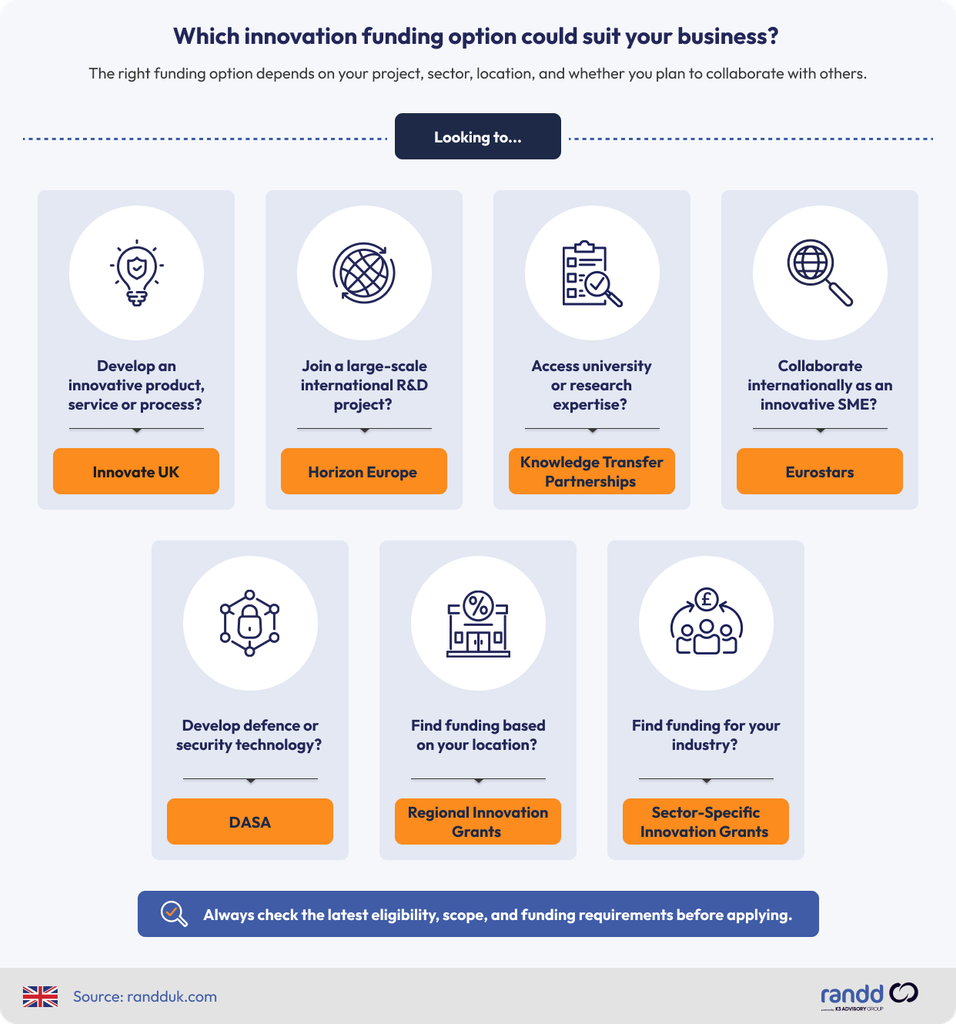
Figure 1: The right funding option depends on your project goals, sector, and whether you plan to collaborate. From Innovate UK to Horizon Europe and sector-specific grants, each scheme supports different types of innovation activity.
Which R&D grant is right for your business?
With so many options available, choosing the right R&D grant can feel like a challenge in itself. The best fit will depend on what you’re developing, where your business is based, who you’re working with and what stage your project has reached.
Use the table below as a starting point:
| If you’re looking to… | Funding route to explore |
| Develop an innovative product, service, or process | Innovate UK |
| Take part in a large-scale international R&D project | Horizon Europe |
| Access specialist expertise from a university or research organisation | Knowledge Transfer Partnerships (KTP) |
| Collaborate with international partners as an innovative SME | Eurostars |
| Develop an innovation with defence or security applications | DASA |
| Find funding based on where your business operates | Regional innovation grants |
| Find funding targeted at your industry | Sector specific innovation grants |
Who is eligible for an R&D grant?
There’s no universal eligibility test for R&D grants. Each funding body and competition sets its own requirements, so being eligible for one doesn’t necessarily mean you’ll qualify for another.
Depending on the opportunity, eligibility may be influenced by:
- The size and location of your business
- Your sector
- The type and stage of your project
- Whether you’re applying alone or with partners
- The level of innovation involved
- Your ability to fund your share of the project costs
Some programmes are open to businesses of all sizes, while others specifically target SMEs, particular sectors, or collaborative projects.
Before you start writing an application, check the eligibility criteria carefully. There’s little value in spending hours preparing a bid for a competition that isn’t a good fit.
What costs can an innovation grant cover?
What you can claim will depend on the funding programme and the type of project you’re undertaking.
Eligible costs may include:
- Staff working directly on the project
- Materials and consumables
- Prototyping and testing
- Subcontractor costs
- Specialist equipment or facilities
- Travel associated with the project
- Costs associated with project partners
However, don’t assume that every project expense will be covered. Funding bodies usually set clear rules around eligible costs, and you may need to explain and justify them as part of your application.
It’s also worth remembering that the costs accepted under an innovation grant aren’t necessarily the same as those that qualify for R&D Tax Relief. If you’re considering both, look at the two sets of rules separately.
How much funding can a business receive?
There’s no single answer, as the amount of R&D funding available varies considerably between programmes.
Some grants are designed to support smaller feasibility projects, while larger collaborative programmes can provide significantly more funding for ambitious, multi-year R&D projects.
The grant may also only cover a proportion of your eligible project costs. How much you’ll need to contribute yourself can depend on factors such as:
- The funding programme
- Your business size
- The type of R&D being carried out
- Whether you’re working with other organisations
Rather than choosing an opportunity based on the headline funding figure alone, consider how much you’ll actually receive, what you’ll need to contribute and when payments will be made.
When should you look for R&D funding?
Ideally, start exploring funding opportunities before your project gets underway. Many grants have specific rules around project start dates and eligible expenditure, and application processes can take time.
Planning ahead also gives you more time to find the right competition, understand what you’ll need to contribute and consider how grant funding could fit alongside other forms of innovation support.
How to apply for an R&D grant
Found a funding opportunity that looks promising? Before jumping straight into the application, make sure your project genuinely fits what the funder is looking for.
While every application process is different, you’ll typically need to:
- Check the scope and eligibility criteria. Make sure your business and project meet the requirements before investing time in an application.
- Define your innovation. Be clear about what you’re developing, what’s innovative about it and the challenge you’re trying to overcome.
- Build your project plan. Set out what you’ll do, when you’ll do it and who will be responsible.
- Prepare your costs. Create a realistic project budget and check which costs the funder will accept.
- Explain the commercial opportunity. Show that there’s a genuine market need and a route to commercialisation.
- Review before submitting. Check your answers against the assessment criteria rather than simply describing why you think the idea is good.
- Give yourself plenty of time. Competitive grant applications can require significant technical, commercial and financial detail, and rushing the process rarely helps. If you’d like support putting together a competitive application, find out how our grant funding service works.
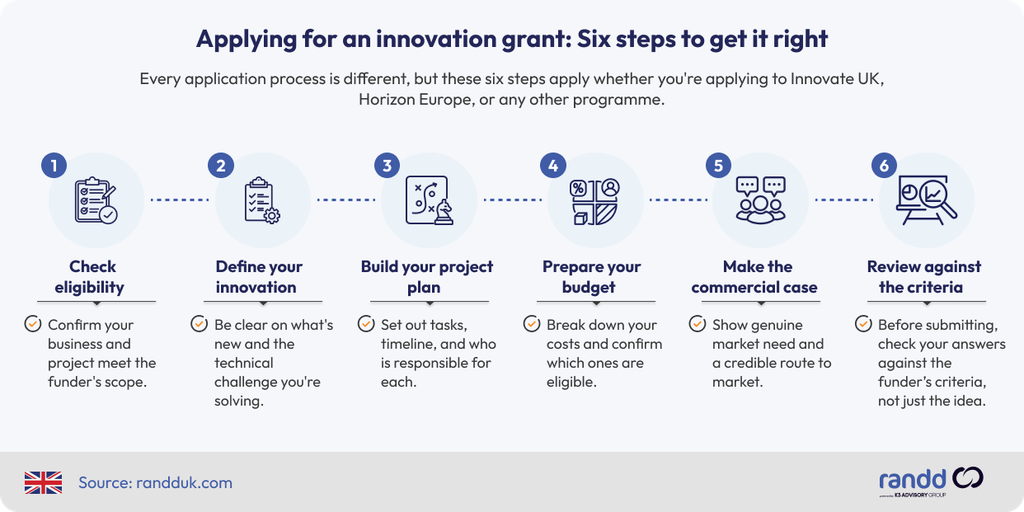
Figure 2: A strong application covers eligibility, a clear innovation definition, a credible project plan, a realistic budget, and a commercial case, whether you’re applying to Innovate UK or any other scheme.
What makes a strong R&D grant application?
A great idea is important, but it isn’t enough on its own. Assessors also need to understand why the project deserves funding and whether your business is capable of delivering it.
What assessors are looking for
While the criteria will vary between funding programmes, assessors will typically want to understand:
- The problem you’re solving: Is there a genuine technical, commercial, or societal challenge that needs addressing?
- What’s innovative about your approach: How does your proposed solution differ from what’s already available?
- The market opportunity: Is there evidence of demand, and is there a realistic route to commercialisation?
- Your project plan: Are the timescales, costs, and resources realistic?
- Your team: Do you and your project partners have the right skills and experience to deliver the work?
- The risks involved: Have you identified the main technical and commercial risks and explained how you’ll manage them?
- Why funding is needed: What difference will the grant make to the project, and what could happen without it?
Above all, make it easy for the assessor to understand your case. Answer the questions directly, back up your claims with evidence where possible, and don’t assume the person reviewing your application will have the same technical knowledge as you.
Common reasons R&D grant applications are rejected
Grant funding is understandably competitive, and even genuinely innovative projects aren’t guaranteed to succeed.
Applications can fall short for relatively simple reasons, such as:
- The project doesn’t closely match the competition scope
- The innovation isn’t clearly explained
- There’s limited evidence of market demand
- The project plan or budget isn’t realistic
- Risks haven’t been thoroughly considered
- The commercial opportunity is unclear
- The application doesn’t directly address the assessment criteria
It’s a good idea to try reading your application from an assessor’s perspective before submitting it. Can someone unfamiliar with your business quickly understand what you’re developing, why it matters, and why funding would make a difference?
R&D grants versus R&D Tax Relief
R&D grants and R&D Tax Relief both support business innovation, but they work in different ways.
A grant provides funding towards an approved project, usually following a competitive application. R&D Tax Relief, on the other hand, is a Corporation Tax incentive available to companies carrying out qualifying R&D activities and meeting the relevant conditions.
| Question | R&D grant | R&D Tax Relief |
| When is support received? | During or around the project, depending on the funding terms | After qualifying expenditure has been incurred and a claim is made |
| Is it competitive? | Usually | No, but statutory eligibility requirements apply |
| Does it need repaying? | Generally no, if the funding conditions are met | No, though claims may be checked by HMRC |
| Is funding project-specific? | Usually | Based on qualifying R&D activities and expenditure |
| Can both apply? | Potentially | The interaction depends on the circumstances and applicable rules |
Can you receive an R&D grant and claim R&D Tax Relief?
Potentially, yes. Receiving grant funding doesn’t necessarily prevent a business from claiming R&D Tax Relief.
However, the interaction between the two can be complex. The treatment will depend on factors including the funding received, the expenditure involved, and which R&D Tax Relief rules apply to your accounting period.
For accounting periods beginning on or after 1 April 2024, companies may claim under the merged R&D scheme or, where the relevant conditions are met, Enhanced R&D Intensive Support (ERIS).
Why early planning makes the difference
That’s why it’s worth considering your tax position alongside your funding strategy rather than looking at the two in isolation. Planning early can help you understand how different forms of support may interact and make sure you’re keeping the records you’ll need later.
Want to know what your business could claim? Our guide to R&D Tax Credits explained covers how the current schemes work, which activities and costs may qualify, and what businesses need to consider when making a claim.
Is there tax support once your innovation starts generating profit?
The support available to your business doesn’t stop once development is complete. There are tax reliefs specifically designed for the stage when your innovation starts generating profit.
While grants can help fund the development of an innovation and R&D Tax Relief can support qualifying R&D expenditure, Patent Box may become relevant when patented innovations begin generating qualifying profits.
Eligible companies can elect into Patent Box to apply a reduced rate of Corporation Tax to qualifying profits associated with patented inventions and certain other qualifying intellectual property.
Not every R&D project will result in a patent or qualify for Patent Box. But if you’re developing potentially patentable technology, considering your intellectual property strategy early could put your business at an advantage further down the line.
You can learn more in our guide to the Patent Box scheme.
Where to find current R&D funding opportunities
Innovation funding is a fast-moving landscape. Competitions open, close, and change scope throughout the year, so an opportunity that’s available to you today may not be there when you come to apply.
Useful places to keep an eye on include:
UKRI and Innovate UK for UK funding competitions
- UKRI Funding Finder – browse all UKRI funding opportunities
- Innovate UK Innovation Funding Service – search and apply for open Innovate UK competitions
Horizon Europe for European research and innovation opportunities
- UKRI – Horizon Europe for UK applicants – guidance and how to apply
- EU Funding & Tenders Portal – where proposals are submitted
DASA for defence and security funding
- UK Defence Innovation – GOV.UK – browse current open calls and competitions
Devolved governments and regional organisations for location-specific support
- Scottish Enterprise – Scotland
- Business Wales – Wales
- Invest Northern Ireland – Northern Ireland
- Growth Hub Finder – England (find your nearest Growth Hub by region)
Local authorities, universities, and industry bodies for local and sector-specific opportunities
- Find a Grant – GOV.UK – searchable database of UK government grants
- GOV.UK Business Finance Support – filter by location and sector
Rather than waiting until you need funding, it’s worth keeping an eye on new opportunities. Finding the right competition early gives you more time to assess whether it’s a good fit for your business, develop your project, and put together a strong application.
Innovation funding FAQs
UK businesses can access R&D grants and innovation funding through programmes including Innovate UK competitions, Horizon Europe, Knowledge Transfer Partnerships, Eurostars and DASA, as well as regional and sector-specific initiatives.
What’s available will depend on your project, business, sector and location, and funding opportunities change throughout the year.
Yes, certainly. Many R&D and innovation grants are open to SMEs, and some programmes are specifically designed with smaller businesses in mind.
That said, eligibility varies between competitions, so check requirements around business size, location, project costs, and collaboration before applying.
Usually, innovation grants are non-repayable provided you meet the terms and conditions of the funding.
That doesn’t necessarily mean the grant will cover everything. Your business may need to contribute towards project costs, provide evidence of expenditure, and meet agreed milestones throughout the project.
Yes. Startups can potentially access R&D funding if they meet the requirements of the relevant programme.
Funders will usually want to see more than a promising idea. You’ll need to demonstrate a credible innovation project, a clear technical or commercial opportunity, and your ability to deliver what you’re proposing.
It depends on the funding programme, but businesses are often expected to contribute towards the project themselves.
The proportion funded can depend on a few different factors, such as:
- Your business size
- The type of R&D being undertaken
- The specific competition rules
Check the funding rate before applying so you know what your business will need to contribute.
Potentially. Receiving a grant doesn’t automatically prevent a company from claiming R&D Tax Relief.
However, the interaction depends on your circumstances, the expenditure involved, and the R&D Tax Relief rules that apply. If you’re considering both, it’s worth looking at your grant and tax position together.
The timeframe varies. Some funding programmes have relatively straightforward application processes, while major Innovate UK or Horizon Europe opportunities can require detailed technical, commercial, and financial submissions.
Remember to factor in the time between preparing your application, submitting it, receiving a funding decision, and the proposed project start date. Looking at the full timeline will give you a much more realistic idea of when funding could become available.
Innovate UK runs different funding competitions throughout the year rather than offering one permanently open grant.
Check the latest Innovate UK and UKRI funding opportunities to see what’s currently available. If there isn’t a suitable competition today, it’s worth checking regularly as new opportunities are launched.

Chloe Twist is a content specialist at randd, creating informative resources on R&D Tax Relief, claim eligibility, and industry developments. She focuses on helping businesses and accountants better understand the R&D tax process, compliance requirements, and the latest changes affecting innovation-focused companies.

Sign up to our Newsletter
Stay ahead with the latest R&D tax insights, funding updates, and innovation trends - straight to your inbox.