Contents
Businesses, startups, universities, and research organisations can use Horizon Europe funding to support the development of innovative products, technologies, and solutions.
As the EU’s main research and innovation programme, Horizon Europe offers funding opportunities across areas such as sustainability, digital technology, healthcare, advanced manufacturing, and clean energy.
Here we explain how Horizon Europe funding works, who may be eligible to apply, the types of funding available, and how UK businesses can navigate funding calls and application processes.
Horizon Europe Funding at a Glance
Exploring Horizon Europe funding? Here’s a quick overview of how the programme works, who can apply and what to consider before reading the rest of our guide.
Key points:
- What is Horizon Europe? Horizon Europe is the EU’s main research and innovation funding programme, supporting organisations developing innovative products, technologies and solutions.
- Who can apply? Eligible applicants can include startups, SMEs, larger businesses, universities, research organisations and public sector bodies, although requirements vary between individual funding calls.
- What can Horizon Europe fund? Opportunities span areas including clean energy, AI, advanced manufacturing, life sciences, digital infrastructure, sustainability and net-zero technologies.
- How is funding awarded? Funding is generally awarded through competitive calls focused on specific themes or innovation challenges, with applicants submitting detailed project proposals.
- Do you need to work with other organisations? Not always, but many opportunities involve collaborative projects between businesses, universities and research organisations across different countries.
- What are lump sum grants? Some projects use fixed funding amounts linked to agreed work packages and milestones, helping simplify cost reporting during the project.
- Will Horizon Europe cover all project costs? Not necessarily. Some programmes use co-funding models, meaning your organisation may need to contribute towards the project alongside the funding received.
- What makes a strong application? Clear innovation, commercial potential, alignment with the funding call, realistic costs and timelines, and strong partnerships where required can all strengthen an application.
- Can you still claim R&D Tax Credits? Potentially. Grant funding can affect how qualifying R&D expenditure is treated, so it’s important to understand how the two incentives interact.
Bottom line: Horizon Europe is one of several innovation funding options available to UK businesses, but applications are competitive. Finding the right funding call, checking the requirements carefully, and preparing a strong proposal are key to giving your project the best chance of success.
What is Horizon Europe funding?
The programme is designed to help organisations develop innovative ideas, support research and commercialisation, and bring new technologies closer to market.
The funding is provided through Horizon Europe, the EU’s main research and innovation funding programme. It supports businesses, startups, universities, and research organisations working on innovative products, technologies, and solutions.
The programme is the successor to Horizon 2020 and focuses on supporting projects across areas such as:
- Sustainability
- Healthcare
- Digital technology
- Advanced manufacturing
- Clean energy
Unlike some UK-only funded schemes, such as Innovate UK, Horizon Europe often places a stronger emphasis on collaboration, with many funding opportunities involving organisations from multiple countries working together on shared innovation challenges.
Although the UK is no longer part of the EU, UK businesses and organisations can still participate in many Horizon Europe funding opportunities through the UK’s association agreement with the programme.
Horizon Europe funding opportunities
The programme covers a wide range of innovation areas and project types, from early-stage research through to commercial development and large-scale collaborative projects. Funding is typically delivered through competitive calls focused on specific themes or challenges. These may include areas such as:
- Clean energy
- Advanced manufacturing
- Healthcare
- Digital technology
- Life sciences
- AI
- Digital infrastructure
- Sustainability
- Net zero technologies
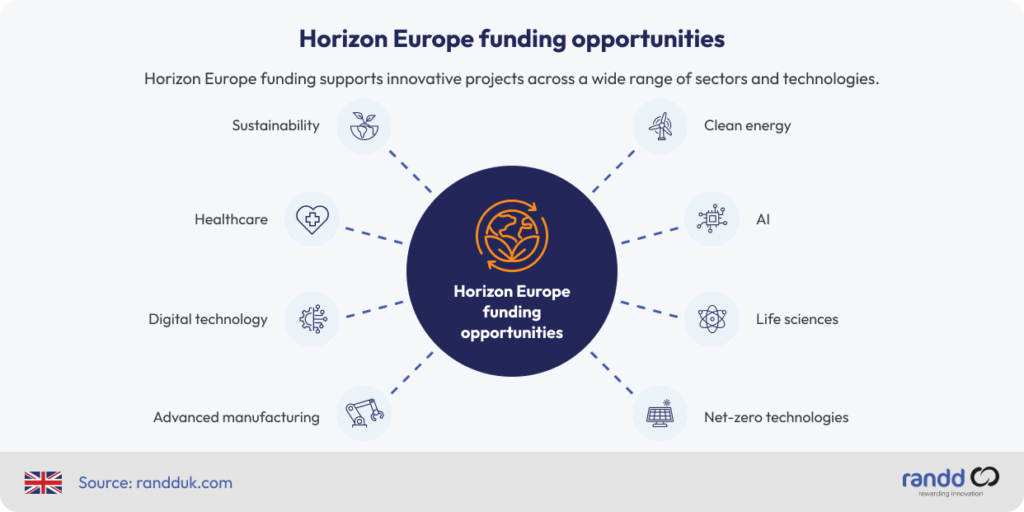
Figure 1: Horizon Europe supports innovation across a wide range of sectors and technologies, from clean energy and sustainability to AI, healthcare and advanced manufacturing.
The type of funding available often depends on the nature of the project, the organisations involved, and how close the innovation is to being brought to market. Some programmes are designed to support exploratory research, while others focus more heavily on commercialisation and real-world implementation.
For many businesses, Horizon Europe funding can form part of a wider innovation strategy alongside other incentives such as Innovate UK grants or R&D Tax Credits. Businesses may also benefit from understanding how combining R&D Tax Relief with grants can support wider innovation and growth plans.
Horizon Europe funding calls
Funding is usually distributed through scheduled calls, where organisations apply for support within a defined topic, challenge, or innovation area.
Each funding call will typically outline:
- The project scope
- Eligibility requirements
- Available funding
- Deadlines
- Expected outcomes
Some calls are broad and open to a variety of technologies or sectors, while others are highly targeted towards specific policy priorities or innovation challenges.
Because funding calls are highly competitive, applicants are expected to demonstrate not only technical innovation, but also clear commercial potential, measurable impact, and a realistic delivery plan.
New Horizon Europe funding calls are published regularly throughout the year, making it important for businesses to monitor upcoming opportunities that align with their innovation goals.
Horizon Europe lump sum funding
Some Horizon Europe projects operate under a lump sum funding model, which is designed to simplify how funding is managed and reported.
Under this approach, projects receive fixed funding amounts linked to agreed work packages and milestones, rather than having to report individual costs in detail throughout the project.
The goal is to reduce administrative complexity and allow organisations to focus more on project delivery and innovation outcomes. However, applicants are still expected to provide clear planning, budgeting, and evidence that the proposed work can realistically be delivered within the agreed funding structure.
Lump sum funding can be particularly attractive for organisations looking for a more streamlined approach to grant management, although the application process can still be highly competitive.
Horizon Europe co-funding mechanisms
Many Horizon Europe programmes operate using co-funding mechanisms, meaning participating organisations may need to contribute part of the project costs themselves.
The level of funding available will usually depend on factors such as:
- The type of project
- Organisation size
- Research category
- Stage of development
In some cases, Horizon Europe may fund a significant proportion of eligible project costs, while businesses are expected to cover the remaining percentage through their own investment or additional funding sources.
Collaborative projects may also involve multiple organisations contributing resources, expertise, or matched funding as part of a wider consortium.
Understanding the financial structure of a funding opportunity early in the process is important, particularly for businesses assessing project viability and long-term commercial return.
Who can apply for Horizon Europe funding?
A wide range of organisations involved in research, innovation, and technology development may be eligible to apply.
Eligible applicants can include:
- Startups
- SMEs
- Larger businesses
- Universities
- Research organisations
- Public sector bodies
Many funding opportunities are designed around collaborative projects involving multiple organisations across different countries and sectors. As a result, businesses may often apply as part of a consortium rather than as a standalone applicant.
However, eligibility and funding rules can vary between individual funding calls and programme areas.
The exact eligibility criteria will vary depending on the funding call, so organisations should carefully consider the guidance for each opportunity before applying.
How does Horizon Europe funding work?
Funding is generally awarded through competitive application processes linked to specific funding calls or innovation challenges.
Organisations applying for funding are typically asked to submit detailed proposals explaining:
- The innovation involved
- Project objectives
- Expected impact
- Delivery plans
- Project costs
- Collaboration arrangements
Applications are then evaluated against several criteria, including innovation, feasibility, commercial potential, scalability, and wider economic or societal impact.
Many Horizon Europe projects involve collaboration between businesses, universities, and research partners, particularly for larger or more technically complex programmes.
Depending on the funding scheme, successful applicants may receive Horizon Europe grants covering a proportion of eligible project costs, with payments linked to project milestones or reporting stages.
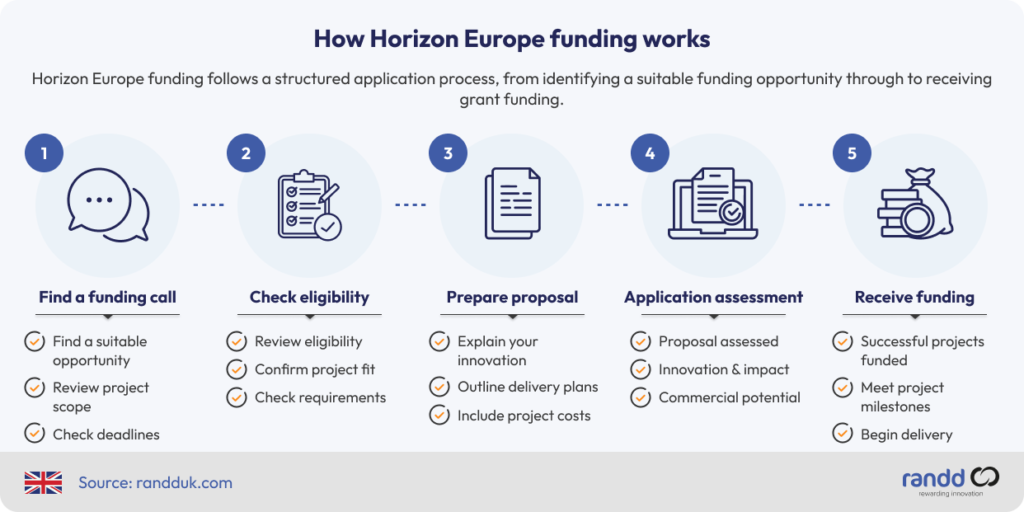
Figure 2: The Horizon Europe application process typically involves finding a suitable funding call, checking eligibility, preparing a detailed proposal and undergoing assessment before funding is awarded.
How to apply for Horizon Europe funding
Applications for Horizon Europe funding are typically thorough and detailed, especially for projects that are large-scale or more collaborative in nature.
The first step is usually identifying a suitable funding call aligned with the organisation’s sector, technology, or innovation objectives. Businesses will then need to carefully review the eligibility requirements, scope of their project, and application guidance before preparing a proposal.
Applications often require detailed information that covers:
- The innovation or research involved
- Commercial potential
- Project delivery plans
- Consortium partners
- Expected outcomes
- Project costs and resources
Since Horizon Europe funding is highly competitive, successful applications will usually combine strong technical expertise with a clear commercial strategy and realistic project plans, and many businesses work with a grant writing consultant to strengthen their application.
Many organisations also spend significant time building partnerships and consortium arrangements ahead of submitting an application, helping strengthen proposals and improve project coordination.
Horizon Europe funding for startups and SMEs
For startups and SMEs working on innovative technologies, products, or services with strong growth potential, the programme can provide valuable funding and support.
For early-stage businesses, funding may help support activities such as research, prototyping, testing, product development, and commercialisation. In some cases, Horizon Europe programmes may also provide access to international collaboration opportunities, industry expertise, and wider innovation networks.
Startups working in areas such as AI, sustainability, advanced manufacturing, healthcare, and clean technology may find particularly strong alignment with current Horizon Europe priorities.
That said, it’s helpful for smaller businesses to be aware that applications can be resource-intensive, particularly where multiple partners and detailed application requirements are involved. Solid preparation and project planning are key factors in creating a competitive application.
Common challenges with Horizon Europe applications
While the programme can offer significant opportunities, the application process is often highly competitive and can be rather complex for first-time applicants.
One of the biggest challenges is the level of detail required to build a strong proposal. Applications are expected to demonstrate not only technical innovation, but also commercial viability, measurable impact, and realistic project delivery.
For projects that involve collaboration across organisations or countries, businesses may also need to coordinate with multiple partners, which can make project planning and management more complex.
Other common challenges can include:
- Understanding eligibility requirements
- Meeting strict deadlines
- Developing realistic project budgets
- Aligning with programme priorities
- Managing compliance and reporting expectations
Even strong projects may not secure funding, which makes strategic planning and preparation particularly important throughout the application process.
Tips for a successful Horizon Europe funding application
Strong applications will usually demonstrate a clear combination of innovation, commercial potential, and practical delivery planning.
Some key areas organisations should prioritise include:
- Clearly explaining the innovation and its intended impact
- Aligning the proposal closely with the funding call objectives
- Demonstrating commercial potential
- Showing strong partnerships with consortium members (if applicable)
- Presenting realistic project costs and timelines
- Supporting claims with evidence where possible
Businesses should also prepare well in advance of application deadlines, particularly where collaborative projects or multiple stakeholders are involved.
Given the competitive nature of Horizon Europe funding, providing as much clarity and strategic planning as possible can make a significant difference in strengthening an application.
Where to find Horizon Europe funding opportunities
Current Horizon Europe funding opportunities are typically published through the European Commission’s Funding & Tenders Portal, where organisations can search active and upcoming funding calls across different sectors and innovation areas.
Businesses can usually filter opportunities by:
- Industry
- Funding type
- Project category
- Research area
- Application deadline
UK businesses can also find guidance and updates through UK Research and Innovation (UKRI) and other innovation support organisations.
Because funding priorities and programme areas can evolve over time, it’s worth checking regularly for new Horizon Europe funding calls and application guidance.
Horizon Europe funding and R&D Tax Credits
Grant funding can play an important role in supporting innovation projects, but businesses should also consider how grant funding may interact with other incentives such as R&D Tax Credits.
Depending on the structure of the funding received, grants can sometimes affect how qualifying R&D expenditure is treated for tax relief purposes. Understanding these rules early can help businesses plan their wider innovation strategy more effectively.
Businesses that have already received grant funding may also want to understand whether they can still claim R&D Tax Credits after receiving a grant.
If you’re exploring how Horizon Europe funding could fit alongside R&D Tax Credits, try our R&D Tax Calculator to estimate the value of a potential claim. And if you’d like tailored guidance on how grant funding may affect your eligibility, get in touch with one of our R&D specialists.

Chloe Twist is a content specialist at randd, creating informative resources on R&D Tax Relief, claim eligibility, and industry developments. She focuses on helping businesses and accountants better understand the R&D tax process, compliance requirements, and the latest changes affecting innovation-focused companies.

Sign up to our Newsletter
Stay ahead with the latest R&D tax insights, funding updates, and innovation trends - straight to your inbox.